
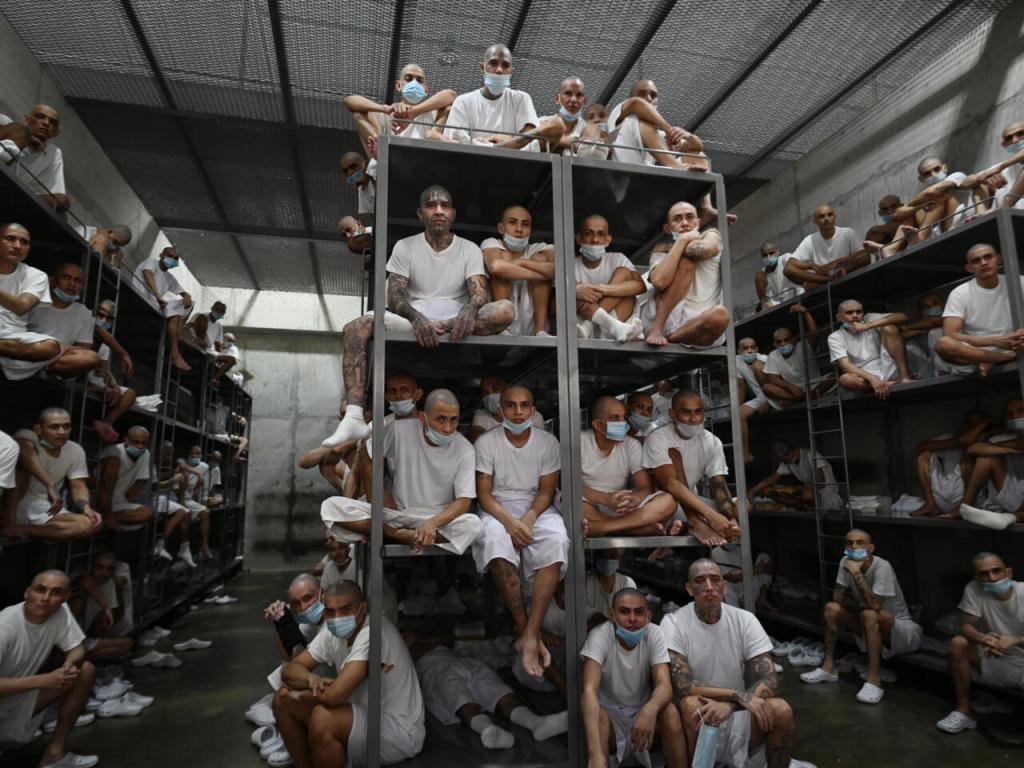
El Salvador’s Centro de Confinamiento del Terrorismo (CECOT) has become emblematic of a disturbing trend: the transformation of detention centers into instruments of state-sponsored brutality. Since its opening in 2023, CECOT has been widely criticized. Human Rights Watch has documented cases of torture, ill-treatment and incommunicado detention within the facility.
The U.S. government’s involvement is equally troubling. Under the Trump administration, the United States has deported more than 300 individuals to CECOT (including legal residents) accused of gang affiliations, often without due process. In one instance, a gay Venezuelan asylum seeker was deported to CECOT based solely on tattoos and social media posts, despite having no criminal record.
Most recently, during a meeting at the White House, President Donald Trump was caught on a hot mic discussing with El Salvador’s President Nayib Bukele the possibility of deporting U.S.-born citizens to CECOT. Trump remarked, “Homegrowns are next. You gotta build about five more places. It’s not big enough,” implying an expansion of his current mass deportation strategy.
With all of this supporting evidence, it would not be mincing words to call CECOT a concentration camp. Merriam-Webster defines a concentration camp as a place where large numbers of people (such as prisoners of war, political prisoners, refugees, or members of an ethnic or religious minority) are detained or confined under armed guard. If the Trump administration can pay to have people detained in a foreign prison for alleged crimes committed in America, then these people are not being deported, they are being held as prisoners of war.
The internet has run wild with theories. Various TikTokers have claimed to have aerial views of CECOT, showing piles of corpses in the open—imagery that invokes memories of the Holocaust. Whether or not that information is accurate, the point remains: CECOT is not a Holocaust-era concentration camp. It is a death camp. Let me explain.
A Brief History of America’s View of the Holocaust
The Holocaust has come to symbolize ultimate evil in the modern Western moral imagination, but that framing developed over time. During World War II, the average American had some information about what was happening, but not the full scope. “Genocide” wasn’t yet part of the vocabulary. The word was coined during the Nuremberg Trials because no term yet existed to describe what had taken place.
What Americans did know about the Holocaust was often met with disbelief or indifference. A 1938 Gallup poll found that 67% of Americans thought Jews were partly to blame for their own persecution. In 1939, a ship carrying more than 900 Jewish refugees was denied entry to the U.S. and forced to return to Europe. More than 250 of those passengers were later murdered by the Nazis.
In 1945, Allied troops began liberating concentration camps. My grandfather was one of those soldiers. Images surfaced for the first time of mass graves and piles of burned bodies, but the focus wasn’t necessarily on the horror of genocide itself. Western propaganda at the time used the camps to highlight how the Nazis treated “their enemies.” Because of pervasive antisemitism in the U.S., many families of Holocaust victims and survivors grieved in silence.
Then America forgot.
During the Cold War, the Soviet Union became the new enemy. Holding Germany accountable for crimes against humanity could mean losing a key ally. The American government reintegrated Nazi officials into positions of power, particularly in intelligence, specifically to fight the USSR.
I could say the Eichmann trial marked the turning point in public perception of the Holocaust, but for most Americans, it wasn’t. The real shift came in 1978, when NBC aired a four-part miniseries titled Holocaust, starring Meryl Streep. More than 100 million Americans watched it. This was followed by a wave of books, films, and media—most notably Schindler’s List in 1993.
That same year, the U.S. Holocaust Memorial Museum opened in Washington, D.C., with bipartisan political support. The museum framed the Holocaust as not only a tragedy, but a warning—a lesson in the dangers of authoritarianism, racism and societal indifference.
How Did the Nazis Decide to Just Start Killing People?
When I was in eighth grade, we read Night by Elie Wiesel, a memoir about his time in various concentration camps. One sentiment we shared as students was: “How could anyone ever let this happen?”
We often teach that Adolf Hitler “hated” Jews, and that this hatred alone inspired a genocide that killed more than 6 million people. But this explanation is oversimplified and inaccurate.
Hate is not innate. It’s taught through family, education and mass culture. And hate alone isn’t enough. The rise of Nazi fascism was built on calculated messaging and coordinated political strategy. Hitler and his Minister of Propaganda, Joseph Goebbels, used antisemitism as a tool to unite Germans around a common enemy.
They campaigned on the idea that Jews were ruining Germany: taking jobs, committing crimes, corrupting culture. When Hitler took power, it was “promises made, promises kept”. The Nuremberg Laws stripped Jews of citizenship and defined Jewishness by blood. Deportations followed.
The Gestapo began arresting Jews in their homes, workplaces, and even places of worship. So many people were being detained that new holding centers (concentration camps) were built to process them.
This is where we are now. But here’s where Germany went next.
The Jump From Deportation to Death Camps
To the German public, Jews were just being relocated, or “resettled to the East.” No one was saying, “We’re going to kill all the Jews.” Goebbels ensured the language was sanitized. Bureaucrats signed train schedules, not death warrants. But they were the same thing.
Eventually, the camps were overcrowded. They were expensive to maintain. Some officials asked: Why not just kill them? Some camps already were through starvation and dehydration.
This led to what the Nazis called the “Final Solution to the Jewish Question.” First came firing squads. Then came something faster and quieter: gas chambers. First carbon monoxide, then Zyklon B—a compound originally developed for pest control.
In some chambers, up to 2,000 people were killed at once. The bodies were burned in crematoria. People living near the camps could smell it. This happened daily, for years.
Parallels: The United States and Nazi Germany
The Nazis located their death camps in occupied Poland outside of Germany to shield the public from the full reality. Today, the U.S. is supporting CECOT, a prison that exists outside our borders. It’s about plausible deniability.
To our knowledge, CECOT does not use gas chambers. But it detains people indefinitely, without trial, in overcrowded cells with limited food, water and medical care. Deaths are already occurring. The cruelty is the point.
The Nazis told the German public the camps were temporary. That they were just holding people until things could be “sorted out.”
But Trump’s administration is skipping the pretense. There is no illusion of temporary relocation. “Homegrowns are next,” he said. And the prison “isn’t big enough.”
They’re not hiding it. And we’re not stopping it.


 If I Can't Dance Club
Leave a comment